For the parents who end the day still running on fumes — there's something you can actually do about it.
Can I paint you a picture?
It's 7:45pm. Dinner is done — technically.
Someone's cup is still on the table. You've answered approximately 400 questions since 5pm, mediated two arguments, and somewhere between the homework folder and the bath time negotiation, you completely lost track of yourself.
And now you're supposed to just... wind down?
Here's what nobody tells you: the way your evening ends is directly shaping how tomorrow morning begins. Not in a guilt-trip way. Your nervous system is still running on fumes — and there's actually something you can do about it.
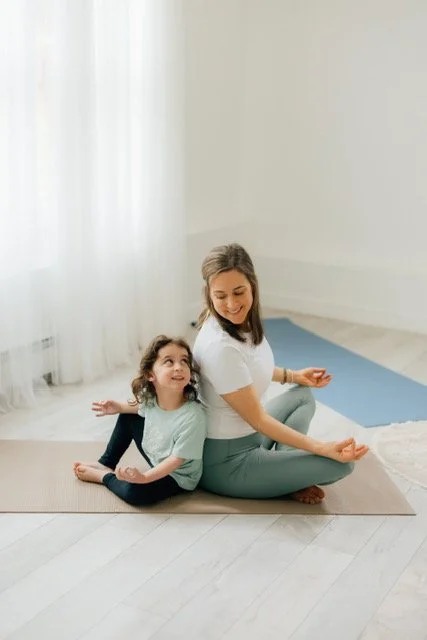
I recently connected with Katie Aissis, founder of Sprouting Tree Yoga, and what she's built is exactly what this season of life calls for. Katie specializes in yoga and mindfulness for kids, moms, and families. Her whole philosophy is grounded in something I deeply believe too: you don't have to choose between taking care of yourself and showing up for your family.
So I asked her to help me map out a simple evening reset. Not a 60-minute flow. Not a perfect routine that requires everyone's cooperation. Just three intentional moments that can shift the entire energy of your household — and yours.
Part 1: Before the Transition — Let the Day Begin to Close
Before we ask children to suddenly shift into "sleep mode," it helps to create small moments throughout the evening that gently guide them there. Bedtime transitions tend to go more smoothly when the nervous system has already started slowing down long before pajamas and lights out.
One thing Katie has noticed as both a parent and children's yoga teacher: bedtime often becomes the first moment kids finally have space to process their day. The questions come out. The worries show up. The sudden burst of energy appears right when we're hoping everyone will magically settle.
That's why creating a gentle "pre-transition" earlier in the evening can make such a difference.
For Katie's family, dinner — or the time right after — is when they intentionally begin slowing the emotional pace of the day. They use a simple reflection game called Rose, Thorn, Bud:
🌹 The Rose — the best part of the day
🌿 The Thorn — something that felt hard
🌱 The Bud — something they're looking forward to
Sometimes the answers are deep. Sometimes they're hilariously random. But the ritual itself matters more than the outcome. It gives children a space to be seen before their head hits the pillow — and gently signals that the day is beginning to come to a close.
These small moments of reflection can help prevent bedtime from becoming the first time emotions finally spill out. Instead of carrying the whole day silently into the dark, kids get a chance to release it — little by little — while they still feel connected, safe, and regulated.
And honestly? Sometimes families need support creating these rhythms, and that's okay. That's part of why Katie created The Family Room membership — a cozy online space where families can slow down, connect, and practice gentle regulation together. Inside you'll find on-demand yoga classes for moms, families, and kids, plus a growing library of digital resources to help little ones regulate and process big emotions. It's designed to feel like an exhale at the end of the day.
Part 2: The Transition — Create the Cue First
Before we ask our bodies (or our kids' bodies) to slow down, it helps to create an environmental cue that says: we are safe, the day is ending, and it's okay to soften now.
This can be simple: dimming the lights, turning off screens, putting on soft music, speaking more quietly, or even changing the scent in the room with lavender spray or a candle. The nervous system responds deeply to rhythm and repetition. These tiny sensory shifts become signals over time.
And unexpectedly? Embrace the silliness if it's there.
Silliness is often the very last thing parents have energy for at the end of the day — but for kids, it can actually be a bid for connection. Sometimes laughter is the release valve. Maybe it's one minute of making ridiculous faces in the bathroom mirror after teeth brushing. Maybe it's wobbling like jellyfish down the hallway, or using a silly voice while helping them into pajamas.
These moments don't delay bedtime as much as we fear they do. Often, they help complete the connection kids were still seeking all evening.
Part 3: The Gentle Practice — Let Them See You First
One thing Katie has learned teaching family yoga: children don't always need us to instruct them. They often just need permission to witness regulation happening in real time.
So instead of announcing, "Okay everyone, time to relax," try beginning with yourself.
Maybe you stretch quietly beside your child's rug. Maybe you fold into child's pose for a few breaths. Maybe you lie on the floor with one hand on your belly and let out an exaggerated exhale. More often than not, curiosity brings them in.
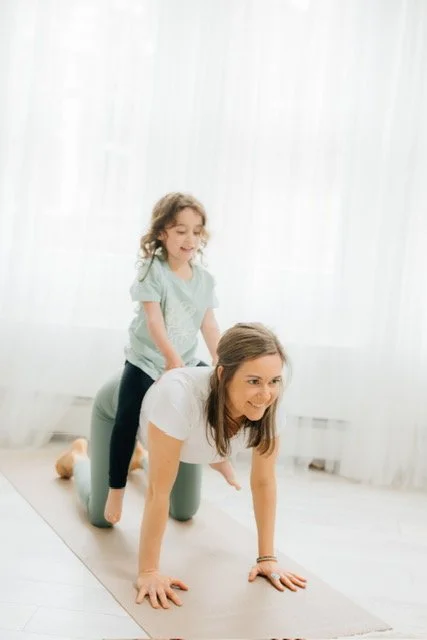
Children naturally mirror what feels safe, slow, and grounded. And when there's no pressure to participate perfectly, the whole thing becomes softer. Some nights it turns into yoga. Some nights it turns into giggles halfway through a stretch. Both still count.
You can also weave in gentle sensory-based practices that feel nurturing and regulating without needing to look like a formal yoga class:
Place a stuffed animal on your child's belly as a "breathing buddy" and watch it slowly rise and fall
Trace shapes, letters, or pictures on their back while they guess what you're drawing
The goal isn't a perfect mindfulness routine. The goal is creating moments where everyone's body gets the message: we can soften here.
The Close: This One Is Just Yours
After the kids are settled, resist the urge to immediately jump into scrolling, cleaning, or catching up on everything left undone.
Instead, try giving yourself five intentional minutes.
Just like children benefit from cues that bedtime is approaching, adults do too. Creating small rituals for yourself can help your own nervous system begin winding down instead of staying stuck in "doing mode."
Maybe it's making a cup of tea while the toys are still scattered on the floor. Maybe it's washing your face slowly, dimming the kitchen lights, stepping outside for fresh air, or simply sitting quietly for a moment before moving into the next part of the night.
And if you want to weave in yoga? It does not have to be elaborate to matter. Some nights it might look like a few gentle reclined twists in bed while you take ten deep breaths. Sometimes that's all we have the energy for — and honestly, sometimes it's all we even need.
Tiny rituals matter. Tiny exhalations matter too.
If this resonates and you want to explore what Katie offers for your family, you can find her at sproutingtreeyoga.com. Her family yoga and slow flow classes were made for exactly the season of life you're in.
You deserve to exhale. Tonight, try it on purpose.